Showing posts with label Health. Show all posts

Thursday, August 26, 2021

Top 25 medical terms we need to know

 While most of us don’t need to understand discipline-specific jargon outside of our own profession, medical terminology is a notable exception. We all need to know what’s going on with our health.


Health News : It’s helpful to know commonly used medical terms...

  
Top 25 medical terms to know
  1. Benign: Not cancerous
  2. Malignant: Cancerous
  3. Anti-inflammatory: Reduces swelling, pain, and soreness (such as ibuprofen or naproxen)
  4. Body Mass Index (BMI): Body fat measurement based on height and weight
  5. Biopsy: A tissue sample for testing purposes
  6. Hypotension: Low blood pressure
  7. Hypertension: High blood pressure
  8. Lesion: Wound, sore, or cut
  9. Noninvasive: Doesn’t require entering the body with instruments; usually simple
  10. Outpatient: Check in and check out the same day
  11. Inpatient: Plan to stay overnight for one or more days
  12. In remission: Disease is not getting worse; not to be confused with being cured
  13. Membrane: Thin layer of pliable tissue that serves as a covering or lining or connection between two structures
  14. Acute: Sudden but usually short (e.g., acute illness)
  15. Angina: Pain in the chest related to the heart that comes and goes
  16. Gastroesophageal Reflux Disease (GERD): Heartburn
  17. Cellulitis: Inflamed or infected tissue beneath the skin
  18. Epidermis: Outermost layer of skin
  19. Neutrophils: Most common type of white blood cell
  20. Edema: Swelling
  21. Embolism: Blood clot
  22. Sutures: Stitches
  23. Polyp: Mass or growth of thin tissue
  24. Compound fracture: Broken bone that protrudes through the skin
  25. Comminuted fracture: Broken bone that shatters into many pieces


Next time you hear one of these terms—whether on TV, in a medical environment, or elsewhere—you won’t miss a beat. Just beware, you may be asked to translate for others.

Monday, May 4, 2020

Benefits of drinking water at the correct time

Benefits of drinking water at the correct time

Drinking water at the correct time maximizes its effectiveness on Human Body.

Drinking Water at the right time

Did You Know! that there are specific times throughout the day when drinking water can actually boost your overall health and cognitive functioning.

"Science shows that drinking water at the correct times of day can help to prevent common problems such as stomach pain, IBS, bloating, fatigue, overeating, high blood pressure, constipation, and even heart attack and stroke"

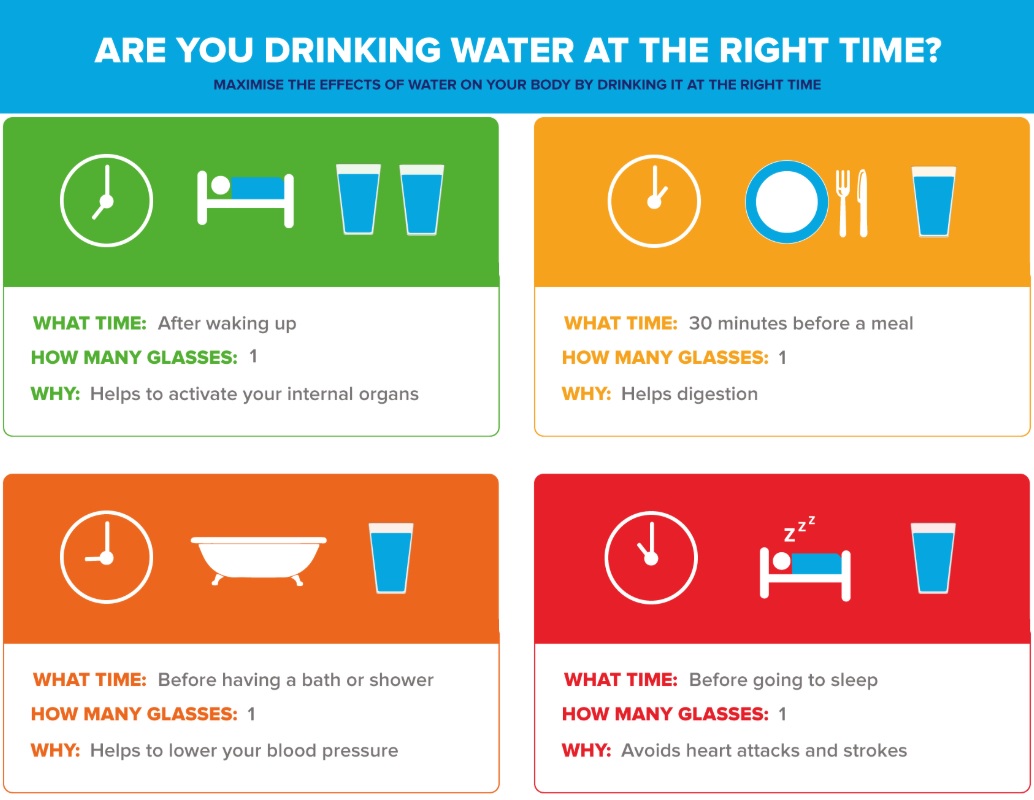
Here’s the best times to drink water, in order to maximize its effectiveness:

1) After Waking Up​:
  • It helps to activate your internal organs & remove any toxins before your first meal of the day.
2) Drink Before you Eat:
  • Before any main meal throughout the day, you should drink a glass of water 30 minutes before to help with digestion & also Drink water 30 minutes after the meal to allow the body to absorb the nutrients.
3) Before a Bath:
  • Drinking one glass of water 10-15 minutes before taking a bath will help lower your blood pressure.
4) Before Sleep:
  • Drink one glass of water an hour before bedtime to replenish any fluid loss that can occur during the night. It also helps avoid stroke & heart attack.
5) Substitute Water During Meals:
  • If you get thirsty during your meal, instead of drinking water, have some Yogurt or Buttermilk instead. It has the cooling effect on your body but does not hamper your digestion. 
6) Drink Water Before & After a Workout:
  • The amount you’ll need depends on your weight, health & whether you exercised in hot or humid conditions.
7) Drink Water Stored in Silver and Copper Vessels:
  • According to Ayurveda, water stored in a copper vessel has the ability to balance all the three doshas in your body, (vata, kapha and pitta) and it does so by positively charging the water. It also has anti-cancer properties. Water in the silver vessel has the power to remove free radicals from the body and gives a cooling effect in the intestines and smoothens the process of digestion.

Stay Hydrated

Thursday, January 2, 2020

2019’s biggest health stories in India

2019’s biggest health stories

From a continued decline in infant and maternal mortality to inadequate funding for healthcare, from poor nutrition to an acute encephalitis syndrome outbreak, and from success in malaria prevention to below-par performance on leprosy control and tuberculosis elimination.

2019 Biggest Health Stories


Here’s a look at 2019’s biggest health stories:

Decrease in maternal mortality, infant mortality

  • India’s infant mortality rate–deaths per 1,000 live births–also fell from 42 in 2012 to 33 in 2017. However, India is still a long way from the Sustainable Development Goal for MMR: a target of 70 deaths per 100,000 live births by 2030. Three Indian states have already achieved this–Maharashtra, Tamil Nadu and Kerala.

Health budget increases, Ayushman Bharat completes a year

  • The Centre has been increasing its allocation to the health ministry, and this year’s budget of Rs 62,659 crore–2.25% of total expenditure–was the highest till date. Also By December 20, 2019, it had covered more than 6.9 million hospitalisations and issued more than 69.4 million e-cards.

Litchis, malnutrition, or heat and humidity?

  • In one of the worst outbreaks of acute encephalitis syndrome (AES) in the state since 2014, 162 children died in Bihar (till July 2, 2019). There are several agents causing AES such as bacteria, fungi and viruses. The most common causes are Japanese encephalitis, Scrub typhus, dengue, measles and even Zika virus.

Malnutrition rampant in children, adolescents

  • One in three (35%) children younger than five years were stunted (low height for age) and underweight, one in six (17%) were wasted (low weight for height), and two in five (41%) were anemic, the first of its kind that gave nutritional status of children aged 5-14 years.

Does air pollution kill or not?

  • One in eight deaths in India was due to air pollution. In 2017, 1.24 million had died due to air pollution, and Indians could live 1.7 years longer if they breathed clean air.

India gets a National Medical Commission Bill

  • This is crucial because India’s current density of healthcare workforce–including doctors, nurses, midwives–per 10,000 population is 20.6 in 2016, compared to 22.8 recommended by the WHO. India would need 250,000 health workers to meet this requirement.

Success in malaria continues

  • India is among the 11 most malaria-affected countries in the world, accounting for 70% of cases globally. In 2018, India registered 2.6 million fewer malaria cases than in 2017. This was 51% fewer than in 2017 and 60% fewer than in 2016. Currently accounting for 3% of global malaria cases, India aims to eliminate the disease by 2030.

Stay Updated Latest News

Monday, July 31, 2017

How Nutritious is a One whole egg is

Eggs are among the few foods that I would classify as “superfoods.” They are loaded with nutrients, some of which are rare in the modern diet.


Eggs are among the most nutritious foods on the planet. A whole egg contains all the nutrients required to turn a single cell into a baby chicken.

A single large boiled egg contains:
  • Vitamin A: 6% of the RDA.
  • Folate: 5% of the RDA.
  • Vitamin B5: 7% of the RDA.
  • Vitamin B12: 9% of the RDA.
  • Vitamin B2: 15% of the RDA.
  • Phosphorus: 9% of the RDA.
  • Selenium: 22% of the RDA.
Eggs also contain decent amounts of Vitamin D, Vitamin E, Vitamin K, Vitamin B6, Calcium and Zinc. This is coming with 77 calories, 6 grams of protein and 5 grams of healthy fats. Eggs also contain various other trace nutrients that are important for health.

Really… Eggs are pretty much the perfect food, they contain a little bit of almost every nutrient we need.

It is true that eggs are high in cholesterol.

In fact, a single egg contains 212 mg, which is over half of the recommended daily intake of 300 mg.

Don't forget to Hit the ♥ & Follow Button for more Updates.